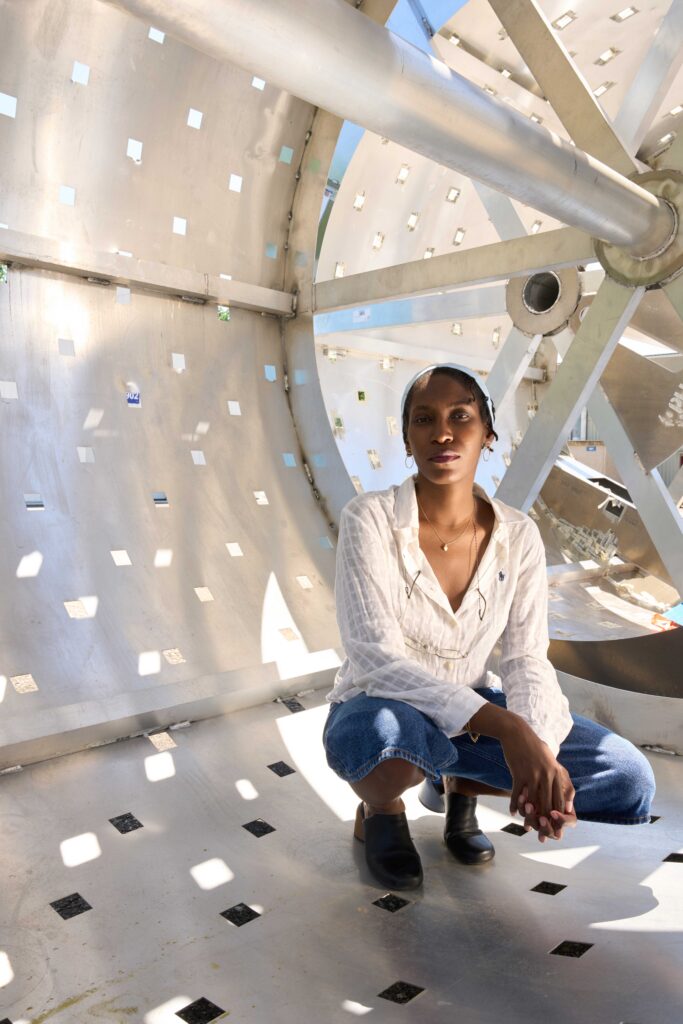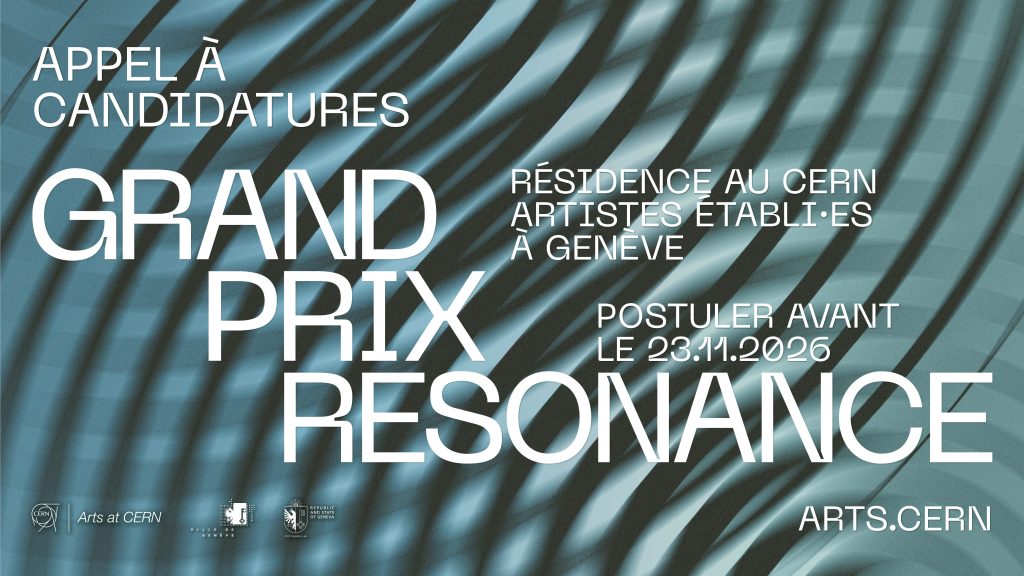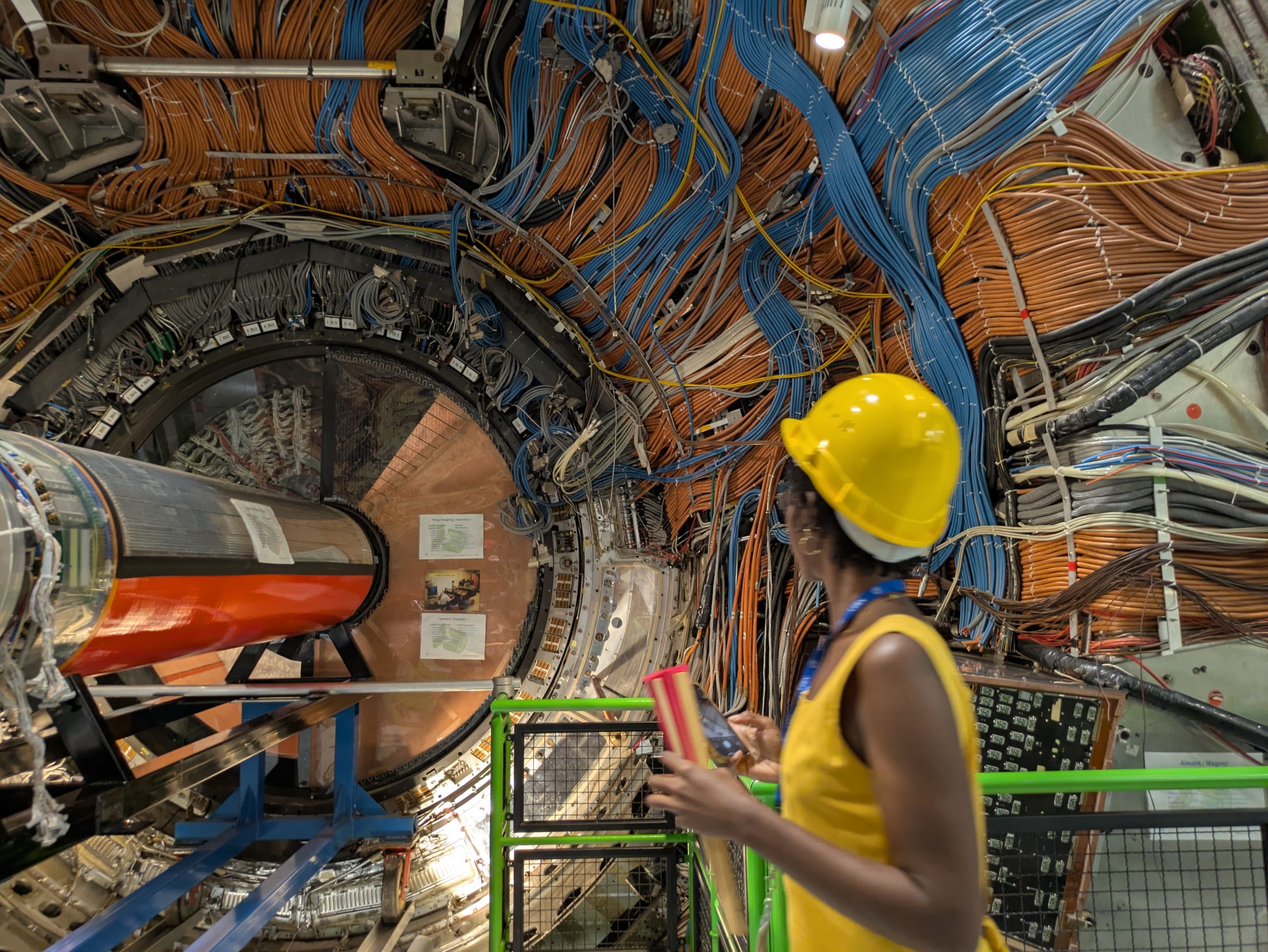
Over the course of June and July, French-Congolese artist Monika Emmanuelle Kazi engaged with the community at CERN as the selected artist for Resonance, the residency programme established in partnership with the Ville de Genève and the Canton and Republic of Geneva.
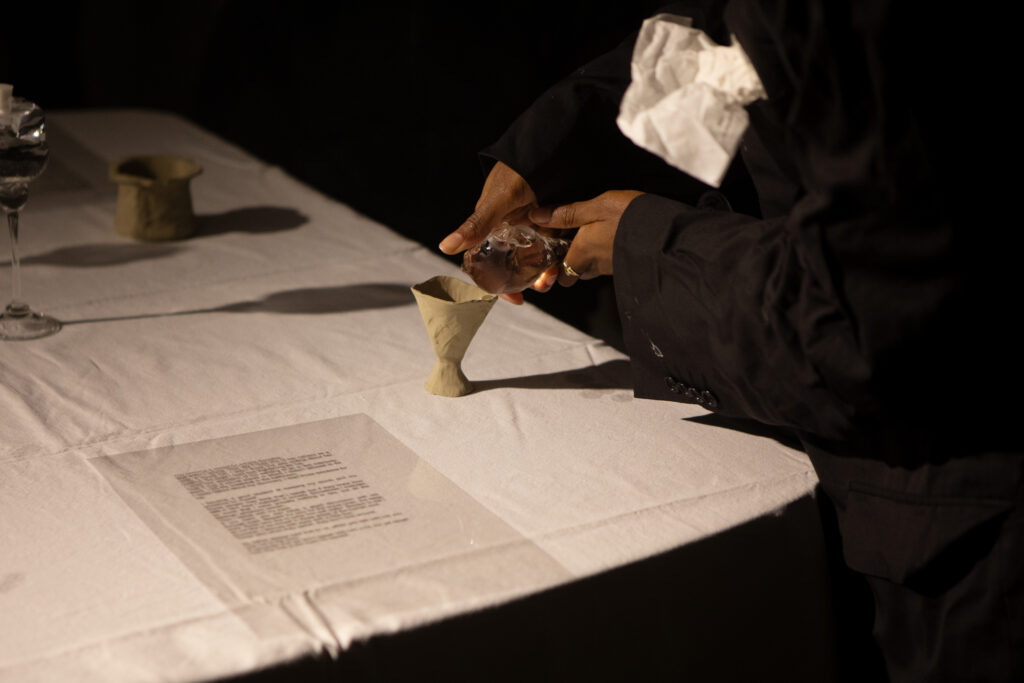
In her artistic practice, Kazi works with installations that include video works, sculptures, textiles, paintings and writing to explore gesture, nostalgia, emotion, and architecture through domestic spaces. The use of objects, family archives and research forms part of a system of visual and everyday references reflecting more globally on the intimacy of the home, the use of territory, and the construction of heritage.
With her proposal Crystalline Memories, Kazi arrived at CERN seeking to explore perceptions of the future through futurology, foresight studies, cosmogonies and cosmology via engaging with scientists and engineers at the Laboratory. During this time, one of the concept Kazi reflected on was that of re-tracing, specifically connecting how the re-tracing of a particle’s journey – through its decays and collisions – can be applied to diasporic memory, the examination of how knowledge is constructed, and how we imagine the future. Speaking with theorists at CERN has also expanded Kazi’s interest in concepts such as the nature of time, symmetry, and quantum theory, using theoretical models to understand how space, time, and matter behave at the most fundamental level.
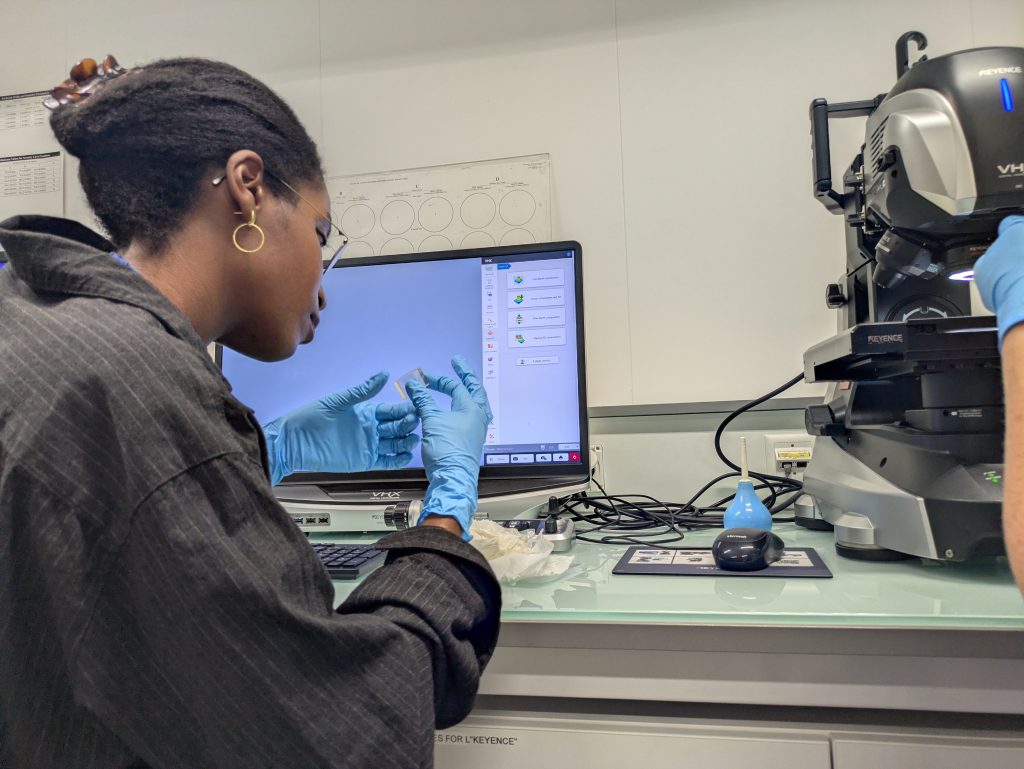
Beyond the theoretical sphere, visiting laboratories such as the Crystal Laboratory and the Thin Film and Glass Lab connected her to materials like glass which she had previously used in her own practice, while also sparking an interest in new materials, in particular metals like copper, a fundamental component of most accelerators. These visits challenged her conception of vision, previously understood in terms of transparency and through the use of light, by offering insight into the observation of what is not visible to the naked human eye and enriching new ways of understanding what it means to see.
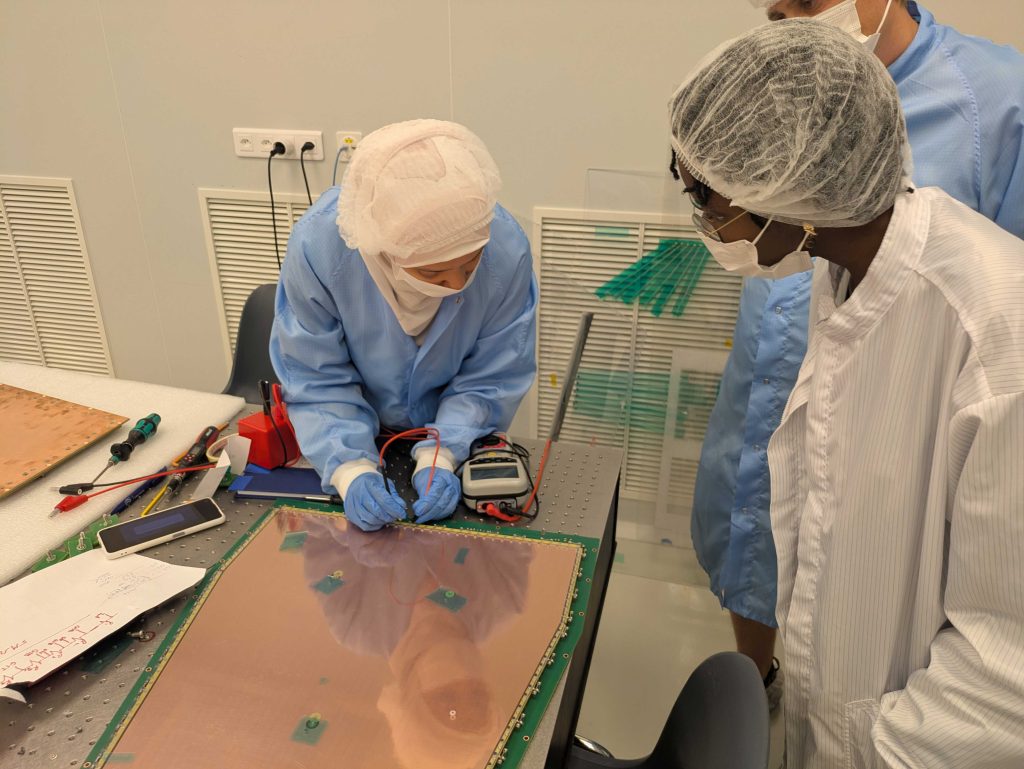
Moreover, through the exploration of glass and metals alike, Kazi has developed a particular interest in the principle of erosion: “Given my attraction to the principle of erosion – the traces, even the shadows, that it can leave over time – it’s possible that in the future I will start using more metals, both for their properties and for the other forms of transparency I encountered in application at the Thin Film and Glass Lab.” The dialogues with scientists at CERN, and the opportunity to closely interact with materials across experiments and facilities, are have opened up new possibilities for Kazi’s artistic practice, a testament to the generative potential of exchanges at both theoretical and practical material levels.