- Venue
- CERN Science Gateway, Geneva, Switzerland
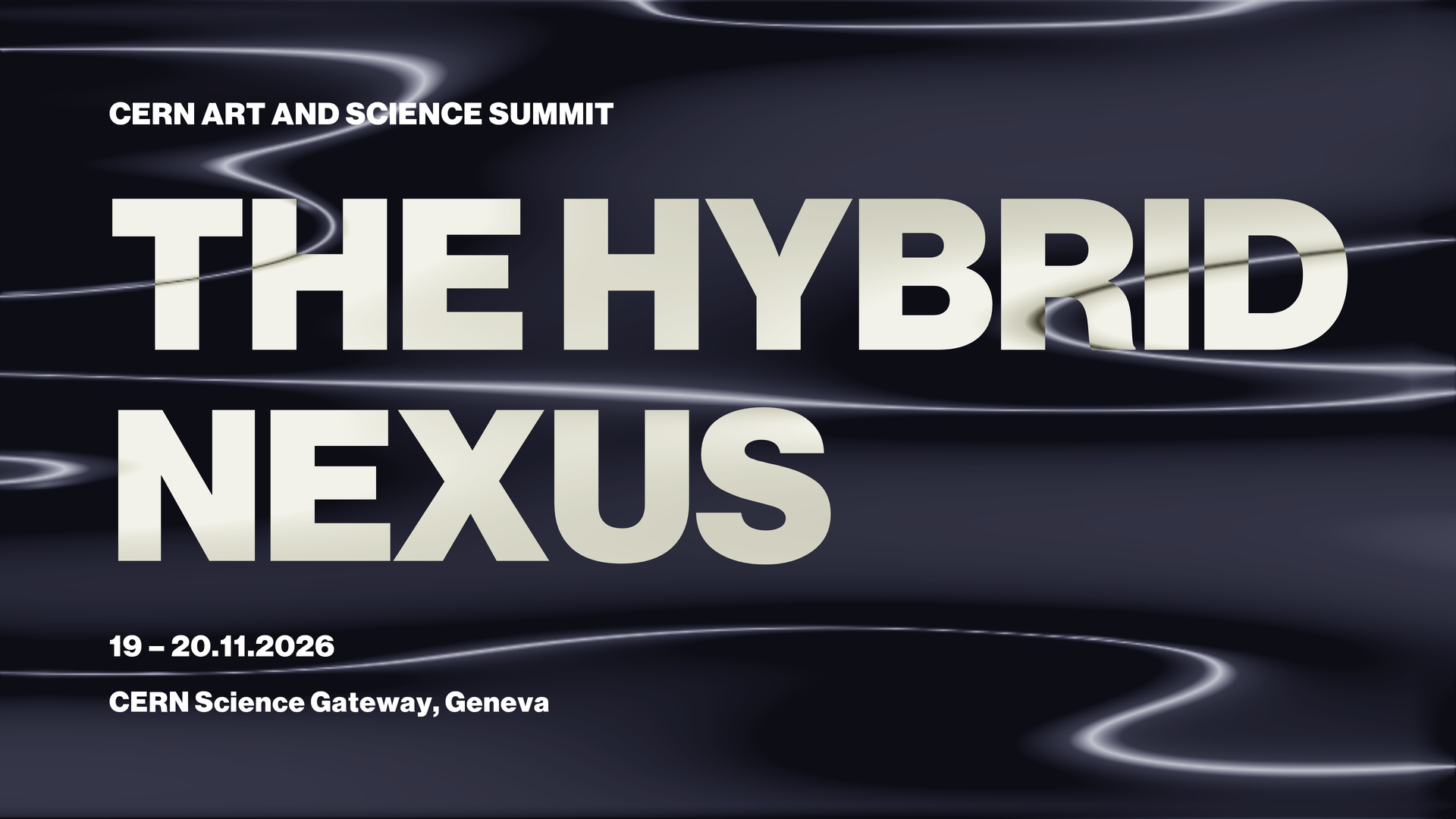
The third edition of the CERN Art and Science Summit, The Hybrid Nexus, explores the convergence of particle physics, quantum technologies, and artificial intelligence, and the ways in which these fields extend beyond the domains of science and technology into artistic inquiry.
- Registration for 19 November – Day 1: Evening Event
- Registration for 20 November – Day 2: Full-day Event
Curated by Arts at CERN, the Laboratory’s arts programme, The Hybrid Nexus reaffirms CERN’s commitment to fostering dialogue between fundamental research, the arts, and contemporary thought. This year’s gathering draws inspiration from the observation posited by mathematician and philosopher Norbert Wiener (1894 – 1964) that the “boundary regions of science” offer “the richest opportunity to the qualified investigator.” The Summit brings together artists, scientists, creative technologists, and thinkers to reflect on the new horizons emerging from this convergence, and their significance for research and contemporary thought across disciplines.
Through keynote presentations, lecture performances, roundtable discussions, and film screenings, The Hybrid Nexus opens a space to trace the hybridisation of research infrastructures and their potential as fertile sites for experimentation and interdisciplinary exploration. It will consider how the evolving relationships between science, technology, and the arts give rise to new conceptual, formal, and applied approaches, as well as broader questions concerning culture, philosophy, and creative practice.
18:00 – 20:30 | Auditorium Sergio Marchionne, CERN Science Gateway
Free admission, registration required
The Summit opens with an evening of keynote presentations by leading figures from science, art, and culture, introducing the central themes of The Hybrid Nexus and setting the stage for the discussions to follow.
17:30 Doors open
18:00 Prelude – Robin Meier Wiratunga, artist and composer
18:15 Institutional Remarks
Ursula Bassler, CERN Director for Stakeholder relations
Enrica Porcari, CERN Chief Information Officer
Giulia Bini, Head of Arts at CERN
18:30 Sabrina Gonzalez Pasterski, theoretical physicist and Deputy Director of Simons Collaboration on Celestial Holography
18:50 Daniel Birnbaum, Professor of Philosophy at the Städelschule Frankfurt and curator
Dr Strangelove: Or How I Learned How to Stop Worrying and Love the Quantum Effect: A century ago quantum physics challenged the very framework through which reality had been understood for centuries. Today, the consequences of this transformation continue to unfold in science, technology and the arts.
19:10 The Hybrid Nexus – Panel Discussion
Maurizio Pierini (CERN), Sofia Vallecorsa (CERN), Daniel Birnbaum and Sabrina Gonzalez Pasterski – moderated by Matthew Chalmers (CERN)
19:40 Marta Kuzma, Professor of Art at the Yale School of Art and curator
The Shadowy Quality of Being At Once Binding and Slack: An exploration of David Bohm’s interpretation of quantum potential alongside Theodor Adorno’s aesthetic theory to reveal their structural affinities. Putting art and quantum in dialogue, the talk addresses how physics and critical aesthetics explore the invisible aspects of reality that underlies the world as we perceive it.
20:00 Lecture Performance – Wendi Yan, artist, writer and technologist
Scales of Vision: Imaging & Imagining the Invisible: Wendi Yan gives a performance lecture traveling through an alternative spacetime, from a metaphysical lab in 1780s Paris, through a Daoist garden of Earth alchemy, to the pink clouds of a speculative Venus. Drawing on the history of science, she builds speculative worlds blending methodologies, philosophies and material cultures into knowledge production. She asks how images of knowledge shift across space and time, and how CERN’s pursuit of basic science has shaped the way knowledge is seen.
20:20 Closing Remarks – Giulia Bini
20:30 End of Event
The event will be held in English, with simultaneous interpretation into French.
10:00 – 16:00: Lectures, roundtable conversations and open-floor discussions
16:40 – 18:30: Film premières
Auditorium Sergio Marchionne, CERN Science Gateway
Free admission, registration required
The second day features in-depth lectures, roundtable discussions, and conversations, offering audience members the opportunity to engage with the speakers. The day explores the intersections of artistic practice, quantum science, and artificial intelligence, while critically examining the emergence of hybrid research configurations and infrastructures.
The day concludes with two film premières by artists Dominique Koch and Marion Tampon-Lajarriette.
09:30 Doors open
10:00 Introduction to Day 2 – Giulia Bini, Head of Arts at CERN
10:10 Metahaven, Artist collective
Tracery: Metahaven’s talk is a (quirky) series of thoughts about computation in its quantum and classical versions. It is about the relationship (and break) between quantum mechanics and historical materialism, the much-debated idea of quantum computation as a physical proof for the Many-Worlds theory of quantum mechanics, and finally, about “artificial humanities” as a narrative exploration of computation. The talk builds on their publications The Hard Question of Art: Cognitive Futures (Verso, 2026) and Art Before Collapse? Poetry, Physics, and Art (2026). In both, art figures as a foundational experiment around the ever-shifting limits of perception and cognition. Tracery, then, is “architectural ornamental work with branching lines”; “decorative openwork” … “work constructed so as to show openings through its substance; work that is perforated or pierced.”
10:40 Declan Colquitt, Head of Studios at Moth and Daniel Bultrini, Lead of Core Research at Moth
Coherence Doping: Steering AI Models with Quantum Computing: Coherence doping, a technique developed by Moth, a quantum computing company, adds tiny deliberate rotations to a quantum search so that, faced with several equally good answers, it consistently favours one that no simple rule can predict. Declan Colquitt and Daniel Bultrini present work Moth made in collaboration with artist and researcher Terence Broad, which uses this approach to steer the preferences of both language and diffusion models, and consider what it suggests about taste and choice in machines and about future intersections of AI and quantum computing.
11:10 Carly Whitefield Head of Programme at LAS Art Foundation
11:20 Quantum – Panel Discussion
Metahaven, Moth and Carly Whitefield – moderated by Giulia Bini
12:00 Lecture performance – Amanda E. Metzger and Martyna Marciniak, artists
0000 0000: The joint lecture-performance between artists Amanda E. Metzger and Martyna Marciniak navigates through their CERN residency projects and the connected works, invoking technical studies, historical scientific anecdotes and conceptual explorations. The talk will translate the uncertainties of reconstruction, operational anomalies, repetitions and error correcting protocols into formal elements, while bridging computational abstractions with infrastructural materiality and embodied gestures.
12:20 Computational Abstractions – Panel Discussion
Verena Kain (CERN), Amanda E. Metzger and Martyna Marciniak – moderated by Giulia Bini
12:50 Lunch Break
14:00 Lívia Nolasco-Rózsás, curator, art historian, author and educator
From Representation to Operation: Taking the entanglement of data and sovereignty as its point of departure, this talk examines how contemporary art moves beyond the critical representation of political and technological power towards an active engagement with the infrastructures that sustain it. Drawing on Marina Vishmidt’s notion of infrastructural critique, it considers how the boundaries between artistic practice and political action become increasingly porous, as artworks engage not only with the visibility of power but with its material, operational, and institutional conditions.
14:20 Rosa Barba artist and filmmaker, co-founder of Art & Science Lab, ETH Zurich
14:30 Hybrid Infrastructures – Panel Discussion
Rosa Barba with Puneet Anantha Murthy (Physicist ETH Zurich), Marta Kuzma, Metahaven and Lívia Nolasco-Rózsás – moderated by Giulia Bini
15:20 Conversation between Dominique Koch, artist, and Enrique Rivera Gallardo, Executive Director of the Centro Interactivo de los Conocimientos – moderated by Giulia Bini
16:10 Lecture Performance – Marion Tampon-Lajarriette, artist
16:20 Closing remarks – Giulia Bini
Film Premières
16:45 – 17:55 The Sound Horizon (2026) (70’) by Dominique Koch
17:55 – 18:30 Dreams Chamber (2026) (35’) by Marion Tampon-Lajarriette
18:30 End of Event
Daniel Birnbaum is a curator, a Professor of Philosophy at the Städelschule Frankfurt and the co-founder of the school’s Institut für Kunstkritik. With Acute Art – a laboratory exploring art and technology – he produced a series of artworks using mixed reality technologies. A contributing editor to Artforum,Birnbaum was previously Director of Moderna Museet and curated the 53rd Venice Biennale in 2009.
Sabrina Gonzalez Pasterski is a theoretical physicist specialising in high energy physics, quantum gravity, and holography. She received her undergraduate degree from MIT before earning her PhD from Harvard University and completing a postdoc at the Princeton Center for Theoretical Science. She joined the Perimeter Institute faculty in 2021. She is the founder and principal investigator of the Celestial Holography Initiative at Perimeter and serves as Deputy Director of the Simons Collaboration on Celestial Holography. Her early work includes discovering the spin memory effect, a new observable in gravitational wave physics, and establishing a framework connecting soft theorems, asymptotic symmetries, and memory effects.
Marta Kuzma is Professor of Art at the Yale School of Art. During her tenure, she has published History of an Art School, a revised history of the school from the perspective of women faculty and graduates. Previously Chancellor of the Royal Institute of Art in Stockholm, she introduced ‘Philosophy in the Context of Art’ and ‘Critical Habitats’ in the curriculum. She directed the Office for Contemporary Art Norway from 2005 to 2023, was a member of the curatorial team for Documenta 13, and in 2004 co-curated the Manifesta biennial in San Sebastian. Most recently, Kuzma served as Artistic Director and Chief Curator of Faktura 10, a platform of events and exhibitions held in war time Ukraine.
Robin Meier Wiratunga is an artist and composer who strives to understand how humans, insects, swarms and objects think. Using techniques from sound and science, he composes thinking tools made with singing mosquitoes, synchronised fireflies, neural networks, and flute-carrying pigeons. Conducted in close collaboration with specialists and scientific labs, his work blends machine learning with animal intelligence. Arranging human, animal and nonbiological actors into constellation-like scores, he creates environments for musical patterns to spontaneously emerge. In 2024, Robin Meier Wiratunga was selected for the Arts at CERN Connect Residency.
Maurizio Pierini is an experimental particle physicist at CERN and a member of the CMS collaboration since 2007. He built a research programme focusing on the exploration of physics beyond the Standard Model by using proton–proton collision data from the Large Hadron Collider. His scientific interests include searches for new particles and phenomena – such as supersymmetry, dark matter, and exotic resonances – as well as the development of innovative strategies for handling the data rates produced by the CMS detector. Pierini has coordinated activities related to advancing real-time data processing and machine-learning techniques for particle physics, contributing to the integration of deep learning methods into reconstruction and analysis workflows. Since 2026, he is the coordinator of the AI activity in the CERN research sector.
Sofia Vallecorsa is a CERN scientist and researcher in the fields of Scientific Computing, Machine Learning and Quantum Computing with applications in High Energy Physics at CERN. She holds a PhD in Physics, with expertise in Machine Learning and Deep Learning, and is currently focusing on the intersection between AI and Quantum Computing. She is the coordinator of the CERN Quantum Technology Initiative, leading a team dedicated to the investigation of the potential impact of quantum technologies in High Energy Physics. Vallecorsa also leads the Computing and Data Science section in the IT Department at CERN.
Wendi Yan is an artist, technologist, writer and historian of science. Based between New York and San Francisco, she constructs speculative epistemologies through research-driven worldbuilding and metafictional simulation, using CGI, game engine and material experimentation to probe the artifice of knowledge. Her work examines the boundaries of the scientific self and imagines alternative histories across the psychogeographies of East and West. An inaugural Steve Jobs Archive Fellow, she won the Grand Prix of the 6th VH Award by Hyundai Motor Group, has received the New Aesthetics grant, and has been in residence at A24 Labs, NEW INC (New Museum), Eyebeam, and The Arctic Circle Expedition. In 2026, she received an Honorary Mention for the Arts at CERN Collide Stockholm international residency award.
Puneet Anantha Murthy is a physicist and assistant professor at ETH Zurich, where he leads a research group at the intersection of quantum optics, materials science and nanotechnology. His work explores new ways of controlling light and matter at the quantum scale, with applications ranging from precision sensing to quantum technologies. He completed his undergraduate studies in physics in Mysore before pursuing a PhD in atomic physics at Heidelberg University. Together with the artist Rosa Barba, he co-teaches the interdisciplinary course “Understanding Light” at ETH Zurich, which brings together perspectives from physics and visual art to explore the nature of light as both a scientific phenomenon and a cultural medium. Their collaboration bridges quantum physics and imagination, seeking to expand how light, perception, and knowledge can be understood through dialogue between disciplines.
Rosa Barba is an artist and filmmaker based in Berlin. She explores themes of permanence, impermanence, reality, and fiction through films, sculptures, installations, publications and performances. Her work examines how space is influenced by temporal and linguistic constructs, challenging traditional narratives and semiotics. Barba deconstructs cinematic elements, merging physical materials with abstract concepts like time and sound. Her art often focuses on natural landscapes and human interventions, blending historical records with personal narratives. Her work is part of numerous collections and has been presented internationally in institutions such as MoMA, New York; Albertina, Calouste Gulbenkian Museum; MAXXI, Rome; Centre Pompidou, Paris; and Tate Modern, London, among others.
Daniel Bultrini is a quantum computing researcher and team lead at Moth, a quantum technology company building applications for the entertainment industry. He works on the foundations of the field, from quantum algorithms, quantum error correction and hardware benchmarking to new paradigms for designing quantum software, and also on how fault-tolerant quantum computers could reshape procedural generation in games. His latest work is on uploading and recovering classical data from quantum computers. Bultrini earned his PhD at Heidelberg University with a thesis on quantum chemistry on quantum computers. His research included work at Los Alamos National Laboratory on error mitigation and partial error correction, and at IBM Research Zurich on quantum subspace expansion. Based in Basel, he explores how artists can treat quantum hardware as a new creative medium.
Declan Colquitt is Head of Studios at Moth, a quantum computing company developing applications for media and entertainment. Studios is the area of Moth that turns the company’s research and technology into public-facing deployments, prototypes and demonstrations that people can experience, use and play. It works with artists, creative technologists and external partners, drawing on the expertise of Moth’s Research and Engineering teams to deliver projects that make quantum computing tangible. Colquitt is also a creative technologist and writer, collaborating with Hannah Cobb as Y7, a Manchester-based duo working at the intersection of new technologies and digital anthropology, expressed through new media art and critical writing. Their texts and works have appeared in 032c, Flash Art, DIS and Do Not Research.
Verena Kain is an accelerator physicist at CERN, with a PhD on the design of the LHC injection protection system. As engineer-in-charge, she was responsible for LHC commissioning and the first LHC run. She served as section leader for the SPS and LEIR accelerators, overseeing the performance and operations teams, and previously led the Efficient Particle Accelerator project. Kain introduced AI and machine learning to the CERN accelerator control rooms, founded the Machine Learning and Data Analytics Community Forum for CERN’s Accelerator sector and managed its AI strategy task force. She founded and ran the first dedicated data science section in the Beams Department at CERN. During a sabbatical at the International Institute for Applied Systems Analysis, she built AI models for climate prediction. Verena Kain’s current research focuses on AI for the FCC era and on AI for climate science and integrated assessment modelling.
Dominique Koch is a visual artist living and working in Basel. In her interdisciplinary practice, she combines video, sound, language and objects to create spatial installations that explore ecology, knowledge production and the relationships between humans and the more-than-human world. Multispecies thinking and experimental connections between different disciplines and areas of knowledge are central to her artistic practice. She describes her works as “thinking laboratories” taking social, scientific and philosophical questions as their starting points, weaving them into complex networks of thought that become perceptible through sensory experience. In 2024, Dominique Koch was selected for the Arts at CERN Connect Chile residency, in partnership with Pro Helvetia.
Martyna Marciniak is a mixed-media artist and researcher based in Berlin. Her artistic practice bridges media theory and legal imaginaries to trace how power inscribes itself through image regimes and visual infrastructures. Her works engage in a form of pataforensics, often playfully poking at the tropes of scientific and forensic aesthetics, revealing their uncertainties, contradictions and lapses. Oscillating between sculpture, video and animation, her works often revisit historical events, contexts and figures in order to write visual counter-histories and smuggle in other ways of seeing. In 2025, she was the recipient of the Arts at CERN Collide Copenhagen international residency award, in partnership with Copenhagen Contemporary.
Metahaven are an Amsterdam-based artist collective. Their recent work centers on the foundational role of poetry within and without AI. Their films and installations have been exhibited and screened at MoMA PS1, New York; Guggenheim Museum, Bilbao; ICA, London; Asakusa, Tokyo; e-flux, New York; State of Concept, Athens; the Gwangju Biennale; the Sharjah Biennial; IFFR; Docs Against Gravity; CPH:DOX; the Museo Reina Sofía; Bangkok International Film Festival, among others. They co-authored Latent Spacecraft: Brains, GANs, Finnegans (2026) which combines an exploration of the latent space of artificial neural networks with a novel interpretation of James Joyce’s Finnegans Wake. Metahaven’s most recent book, The Hard Question of Art: Cognitive Futures is a personal document about art as a form of culture that tests perception within the experiential and cognitive realm.
Amanda E. Metzger is an artist based between Basel, Berlin and Brussels. Her practice revolves around network theory, AI and the tension between data and memories. She is interested in how data is created, constructed, shared, stored and reconstructed, applying this to herself in what she considers a network of selves. Through this multi-bodymind form and entity, she explores how systems and networks function by collecting material such as images, audio and text. Her practice employs custom software written specifically for each work. In exhibitions, these works take shape as installation, moving images, prints or Web-based pieces. In 2025 she was the recipient of the Connect residency at Arts at CERN, in partnership with Pro Helvetia.
Lívia Nolasco-Rózsás is a curator, art historian, author and educator. From 2019 to 2023, she served as the curatorial and research lead of the Beyond Matter project at ZKM, Karlsruhe, collaborating with institutions such as the Centre Pompidou, Paris. Nolasco-Rózsás has published extensively, recently editing the volumes DATAS and Beyond Matter, Within Space. Since 2023, she has held a lecturer position in curation and media practice at University College London, while concurrently participating in a research project on digital exhibition practices at ECAL, Lausanne. Her curatorial practice investigates the genealogy and societal impact of planetary computation, electronic surveillance and the possibilities of the virtual condition. She was commissioned by ifa – Institut für Auslandsbeziehungen to co-curate the online platform and traveling exhibition ARE YOU FOR REAL and was invited by the Goethe-Institut to curate DATAS: The Data and the Sovereign at Galerie Rudolfinum, Prague.
Enrique Rivera Gallardo is a Chilean curator, researcher and filmmaker whose research and practice focus on expanded cinema and on the exchanges between art, science and technology. Rivera Gallardo previously directed Galería Persona in Santiago and was in residence at ZKM Karlsruhe between 2005 and 2007. He directed the Chilean Media Arts Biennial from 2012 to 2022, and presided over the Chilean Video and Electronic Arts Corporation, organising exhibitions, commissions and interdisciplinary collaborations with artists, scientists and institutions in Chile and abroad. He is currently Executive Director of the Centro Interactivo de los Conocimientos (MIM), where he has created a media library and documentation center, the Adriana Hoffmann Forest and the Centro de Cultura Científica Mirador Copernicus.
Marion Tampon-Lajarriette is a Franco-Swiss artist living and working in Geneva. She graduated with a Master’s degree in Arts and New Media from HEAD, Geneva. Her work is driven by several major themes: phenomena related to vision and memory, access to the invisible and the construction of knowledge. Her works, which take the form of immersive installations incorporating film, text, sound, performance and appropriated materials, often stem from collaborative methodologies through site-specific research and transdisciplinary dialogues between scientists, artists and healers. Marion Tampon-Lajarriette was the recipient of the first edition of the Arts at CERN Resonance residency in 2025.
Carly Whitefield is Head of Programme at LAS Art Foundation, Berlin. Since joining LAS in 2023, she has curated the projects Natasha Tontey: The Phantom Combatants at Ateneo Veneto, Venice; Pierre Huyghe: Liminals at Halle am Berghain, Berlin; Laure Prouvost: WE FELT A STAR DYING at Kraftwerk Berlin and Grand Palais, Paris; Josèfa Ntjam: swell of spæc(i)es, a Collateral Event of the 60th International Art Exhibition – La Biennale di Venezia; Lawrence Lek: NOX at Kranzler Eck, Berlin; Marianna Simnett: GORGON at HAU2, Berlin; and Alexandra Daisy Ginsberg: Pollinator Pathmaker at Museum für Naturkunde Berlin. She previously worked as Assistant Curator, International Art, at Tate Modern, London, and as Editorial and Research Associate at Oslo Pilot.